🌪️ Introduction: It Wasn’t the Storm


6
When a tree falls, most people point to the same culprit: wind …. . But after evaluating hundreds of tree failures, I can tell you this with confidence:
Storms don’t usually cause tree failure — they expose it.
In professional arboriculture, we don’t stop at what happened, but we really need to take a step bakc and analyze why it happened.
And that comes down to a simple, framework that I like to go by.
🧠 The 3-Factor Model of Tree Failure
MANY tree failures can be broken down into three components:
1. Predisposing Conditions
These are the underlying weaknesses that were already present.
- Internal decay
- Poor structural form (codominant stems, included bark)
- Root damage or restriction
- Chronic stress (soil issues, disease)
👉 These are often visible before the failure — if you know what to look for.
2. Contributing Factors
These conditions weaken the tree further over time.
- Soil compaction (one of the most common issues I see)
- Construction damage to roots
- Grade changes or fill soil
- Poor pruning practices
👉 These factors don’t usually cause immediate failure — they quietly set the stage.
3. Triggering Event
This is the final push.
- Wind
- Ice / snow loading
- Car Colission
👉 The trigger gets the blame… but it’s rarely the “root” cause 😏
🌱 Root Plate Failure: When the Foundation Gives Out


This is one of the most common types of failure — and one of the most misunderstood.
What it looks like:
- The tree is uprooted
- A large disk of soil is lifted with the roots
- The trunk remains mostly intact
What actually might have caused it:
- Root decay
- Compacted or poorly drained soil
- Root loss from trenching or construction
- Long-term restriction of the root system
👉 Professional insight:
When roots fail, it’s almost always due to conditions that developed over years, not hours.
🪵 Trunk (Stem) Failure: Structural Weakness


When a trunk snaps, it often surprises people.
It shouldn’t.
Common indicators:
- Hollow or decayed interior wood
- Fungal growth (conks)
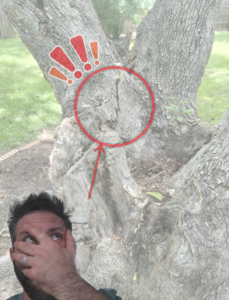
- Vertical cracks or seams
- Weak branch unions with included bark
👉 Key takeaway:
Wood fibers are incredibly strong — until they’re compromised.
🌿 Limb Failure: The Hidden Impact of Bad Pruning


6
This is where human influence shows up the most.
Frequent causes:
- Lion’s tailing (removing interior foliage)
- Excessive end weight on long limbs
- Poor reduction cuts
- Weak attachment angles
👉 Real talk:
Bad pruning doesn’t just make trees look ugly — it makes them dangerous.
⚖️ Act of God vs. Negligence: Where Liability Comes In
This is the question that matters most in insurance and legal cases.
A true “Act of God”:
- No visible defects
- Tree was structurally sound
- Failure occurred under extreme, abnormal conditions
Negligence:
- Dead or declining tree left standing
- Visible defects ignored
- Improper pruning practices
- Known risks not addressed
👉 Bottom line:
Liability is not about the storm — it’s about whether the risk was foreseeable.
🔍 How to Spot a Problem Before It Becomes a Failure
You don’t need to be an arborist to catch early warning signs.
Look for:
- Leaning trees or recent soil movement
- Mushrooms at the base
- Cracks in the trunk or major limbs
- Deadwood in the canopy
- Construction activity near the tree
👉 If multiple signs are present, the risk increases significantly.
📣 Final Thoughts: Tree Failure Is Predictable
Tree failures may seem sudden… but they rarely are.
|In most cases, there were warning signs — sometimes for years.
Understanding how and why trees fail doesn’t just protect property.
It protects people.
👉 Need a Professional Opinion?
If you’re dealing with a tree that you’re unsure about — or a failure that’s already happened — I offer digital consultations to help you get clear, professional answers.
No guesswork. No fluff. Just real arboricultural insight.
👉 Schedule here: https://www.arboristondemand.com
My Best,
Matt Latham
ISA Board Certified Master Arborist #TX-3737B
ASCA Registered Consulting Arborist #859
ASCA Tree & Plant Appraisal Qualified
409.995.7940 | www.arboristondemand.com