Why Healthy Trees Suddenly Fall Over: The Hidden Importance of the Root Flare
Matt Latham·July 6, 2026·0 comments
By Matt Latham, BCMA #TX-3737B, RCA #859 ISA Board Certified Master Arborist • ASCA Registered Consulting Arborist
Most people look up when they’re concerned about a tree.
They notice dead branches, thinning leaves, cavities in the trunk, or limbs hanging over the house. Those are certainly important observations, but one of the most critical parts of a tree is usually hiding in plain sight—right at ground level.
It’s called the Root-Stem Transition Zone (RSTZ), and it’s one of the most important structural components of the entire tree. If you’ve ever wondered why a tree that “looked perfectly healthy” suddenly uprooted during a hurricane or severe thunderstorm, the answer often begins here.
The Tree’s Structural Foundation
The Root-Stem Transition Zone is where the trunk transitions into the large structural roots that anchor the tree into the soil. This area includes the root flare, root collar, and the upper portions of the major structural roots.
Think of it as the foundation of your home.
A house can have beautiful walls and a brand-new roof, but if the foundation begins to fail, everything above it is at risk.
Trees work much the same way.
Every gust of wind that pushes against the canopy creates enormous forces that travel down the trunk and into the structural roots. Those roots distribute the load into the surrounding soil, helping keep the tree upright.
When that system becomes compromised, so does the tree’s stability.
What Science Is Teaching Us About Tree Stability
A fascinating study published in Arboriculture & Urban Forestry examined exactly how mechanical forces move through the Root-Stem Transition Zone.
Researchers subjected fifteen mature pin oaks to carefully controlled pulling tests while using advanced digital imaging technology to measure the strain occurring where the trunk meets the structural roots.
Their findings confirmed something many experienced arborists have long suspected.
The windward and leeward structural roots carry the greatest mechanical loads during wind events. These roots are doing much of the heavy lifting when a tree resists strong winds. The tangential roots, while still important, experience significantly less overall strain and appear to play a larger role in resisting twisting (torsional) forces.
Why does that matter?
Because not all roots contribute equally to tree stability.
If construction severs or damages one of the primary structural roots that carries these mechanical loads, the effect on stability can be much greater than homeowners realize—even if the tree appears perfectly healthy for years afterward.
If you want a DEEP dive into the sciencey stuff, you can download the paper here:
One of the biggest misconceptions about tree failures is that they happen without warning.
In reality, trees often provide clues that something is wrong. The challenge is that many of the most significant defects occur below ground or inside the wood where they can’t be seen during a normal visual inspection.
Common warning signs include:
Mushrooms growing around the root flare
Cavities near the base of the trunk
Soil lifting or cracking after storms
Exposed or damaged structural roots
Large girdling roots
Leaning trees
Construction within the Critical Root Zone
Previous trenching or excavation near the tree
These symptoms don’t necessarily mean a tree is dangerous, but they do indicate that a closer evaluation may be warranted.
Construction Damage Is More Serious Than Most People Realize
One of the leading causes of long-term tree instability isn’t disease.
It’s construction.
Installing driveways, sidewalks, swimming pools, irrigation systems, utilities, foundations, or even new landscaping often damages the structural roots responsible for anchoring the tree.
Unlike a broken branch, root damage usually doesn’t show immediate symptoms.
Instead, the effects may take several years to become visible. During that time, decay organisms can enter damaged roots, gradually weakening the very part of the tree responsible for keeping it standing.
By the time symptoms appear in the canopy, significant structural deterioration may already exist below ground.
Why Trees Sometimes Fall While Looking Perfectly Healthy
Trees are remarkably resilient.
They compartmentalize injuries, produce new wood around damaged areas, and continue growing despite internal defects. That’s one reason a tree can appear vigorous while significant internal decay is quietly progressing beneath the bark.
Appearance alone simply doesn’t tell the whole story.
As consulting arborists, we’ve evaluated many trees that looked healthy from the outside but contained extensive hidden decay within the lower trunk or root flare. We’ve also evaluated trees that appeared alarming but still possessed sufficient sound wood to remain viable with proper management.
That’s why objective diagnostics are so valuable.
Looking Inside a Tree Without Cutting It Open
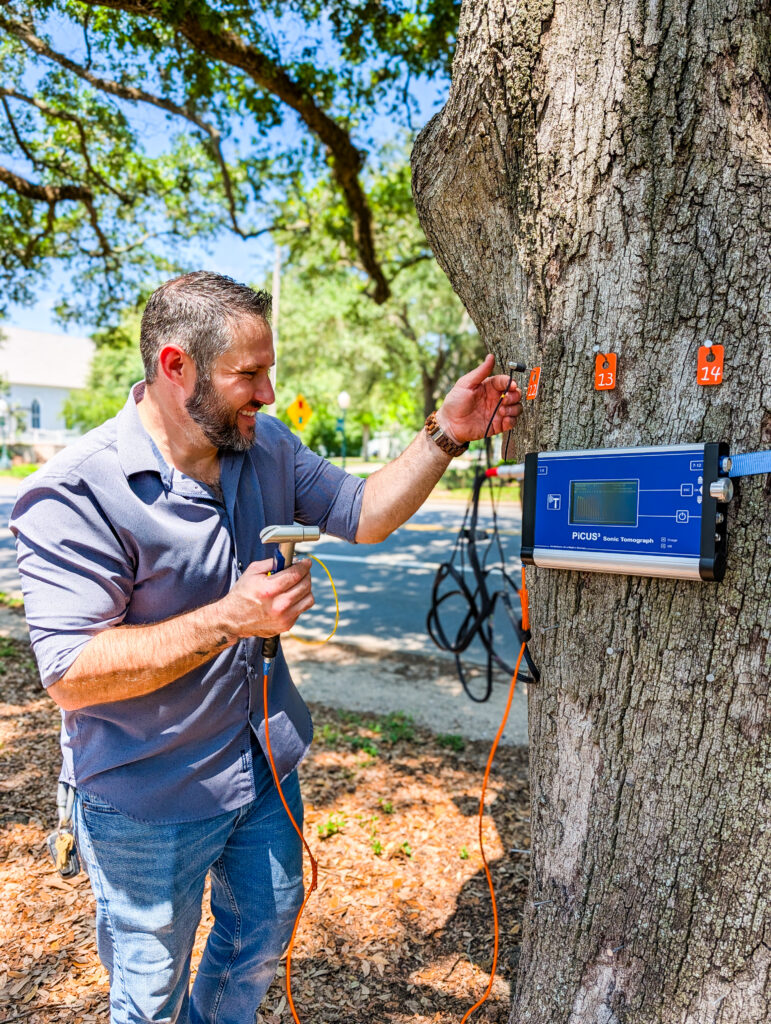
One of the most exciting advances in tree risk assessment is internal imaging like sonic tomography.
If you’ve never heard of it, imagine an MRI or CT scan—but for trees.
Small sensors are temporarily attached around the trunk and transmit sound waves through the wood. Because sound travels differently through healthy wood than it does through decayed wood or cavities, specialized software creates a color-coded image of the tree’s internal condition.
Instead of guessing, we can actually evaluate what’s happening inside the tree.
This technology is especially valuable for:
– Historic Trees – Large shade trees near homes – HOA & municipal trees – Trees with mushrooms or cavities – Trees damaged during construction – Trees with suspected root or buttress decay
In many cases, sonic tomography helps preserve valuable trees by showing they remain structurally sound.
In other cases, it identifies hidden defects before they become catastrophic failures.
The goal isn’t to find reasons to remove trees. It’s to understand their actual structural condition so homeowners can make informed, science-based decisions.
Hurricane Season Is the Worst Time to Discover a Hidden Defect
Here along the Texas Gulf Coast, hurricane season reminds us every year that strong winds are inevitable.
While no arborist can guarantee how a tree will perform during an extreme weather event, identifying hidden structural defects before hurricane season provides the opportunity to reduce risk while there’s still time to act.
Many trees that fail during hurricanes weren’t perfectly healthy to begin with. Internal decay, compromised structural roots, previous construction damage, and hidden defects within the Root-Stem Transition Zone often go unnoticed until powerful winds expose those weaknesses.
If you have a large tree growing close to your home, especially one with mushrooms near the base, visible cavities, previous construction nearby, or signs of root damage, now is the ideal time to have it professionally evaluated—not after a named storm is already approaching the Gulf.
Every Tree Needs an Individual Assessment
No two trees are exactly alike.
Species, age, soil conditions, root architecture, decay, storm history, construction impacts, and overall health all influence how a tree responds to wind loading.
That’s why tree risk assessment should never rely on appearance alone.
Advanced diagnostic tools, combined with experience in tree biomechanics and risk assessment, provide a much clearer picture of what’s happening below the surface.
The Bottom Line
The most important part of your tree may be the part you rarely notice.
The Root-Stem Transition Zone serves as the tree’s structural foundation, transferring enormous forces from the trunk into the root system every time the wind blows. When this area is compromised by decay, root damage, or construction, the consequences can be significant—even if the tree still looks healthy.
Understanding what’s happening below ground is often just as important as evaluating what’s happening above it.
For homeowners, especially those preparing for hurricane season, proactive assessment is one of the smartest investments you can make to protect both your property and the trees you value.
Is It Time to Take a Closer Look?
If you have a mature tree near your home, mushrooms growing around the root flare, visible cavities, recent construction nearby, or simply want greater confidence heading into hurricane season, a professional evaluation can provide valuable peace of mind.
At Arborist On Demand, we combine advanced tree biomechanics, decades of consulting experience, and sonic tomography to evaluate internal decay without harming the tree. As Houston’s only ASCA Registered Consulting Arborist® and an ISA Board Certified Master Arborist®, our goal is simple: provide objective, science-based information so you can make informed decisions that preserve valuable trees whenever possible while helping protect people and property.
My Best,
Matt Latham ISA Board Certified Master Arborist #TX-3737B ASCA Registered Consulting Arborist #859 ASCA Tree & Plant Appraisal Qualified 713.385.7040 | www.arboristondemand.com